
Introduction
Imagine calculating an average where some numbers matter more than others. A student exam might count more than homework, or a company’s revenue from one region might outweigh another. That’s exactly where the concept of how to do weighted average becomes incredibly useful.
If you’ve ever wondered why some calculations don’t simply use the normal average, the answer lies in weighting. A weighted average assigns different levels of importance to each value. It’s widely used in statistics, finance, accounting, grading systems, and data analysis.
Understanding how to do weighted average isn’t just for mathematicians or analysts. In reality, it’s a practical skill used in everyday decision-making—from calculating GPA scores to determining stock portfolio performance.
Once you grasp the idea behind it, you’ll notice how often it appears in real life. Let’s explore the concept step by step so that by the end of this guide, calculating weighted averages will feel completely natural.
Understanding Weighted Average
A weighted average is a type of average where each value contributes differently to the final result. Instead of treating all numbers equally, it multiplies each number by its assigned weight.
In statistics, a weighted average reflects the importance or frequency of different data points.
For example:
| Score | Weight |
|---|---|
| 80 | 20% |
| 90 | 30% |
| 70 | 50% |
Instead of simply averaging the numbers, the weights influence the result.
Simple Definition
A weighted average is calculated by multiplying each value by its weight, summing the results, and dividing by the total weight.

Why Weighted Averages Are Important
The idea of weighting helps represent reality more accurately. Many situations require certain numbers to matter more than others.
Consider these real-world scenarios:
- University grading systems
- Stock market portfolio analysis
- Business performance metrics
- Economic indicators
- Survey results and polling data
If everything were averaged equally, the result could be misleading.
For example, imagine a student scoring:
- Homework: 90
- Midterm: 70
- Final exam: 85
If the final exam counts more heavily, the true performance should reflect that weighting.
That’s why understanding how to do weighted average helps provide a more realistic representation of data.
The Weighted Average Formula Explained
The formula is straightforward once you understand the components.
Weighted Average Formula:Weighted Average=∑Weight∑(Value×Weight)
Where:
- Value = the number being averaged
- Weight = the importance assigned to that value
Example Calculation
| Value | Weight | Value × Weight |
|---|---|---|
| 80 | 2 | 160 |
| 90 | 3 | 270 |
| 70 | 5 | 350 |
Total:160+270+350=780
Total weights:2+3+5=10
Weighted Average:780÷10=78
This method is the foundation for learning how to do weighted average in mathematics, finance, and analytics.

Step-by-Step Guide on how to do weighted average
Let’s break the process down into simple steps anyone can follow.
Step 1: Identify Values
List all numbers that need to be averaged.
Example:
- 75
- 85
- 95
Step 2: Assign Weights
Each value receives a weight depending on its importance.
Example:
| Score | Weight |
|---|---|
| 75 | 1 |
| 85 | 2 |
| 95 | 3 |
Step 3: Multiply Values by Weights
| Score | Weight | Result |
|---|---|---|
| 75 | 1 | 75 |
| 85 | 2 | 170 |
| 95 | 3 | 285 |
Step 4: Add Results
75+170+285=530
Step 5: Divide by Total Weight
Total weights:1+2+3=6
Weighted average:530÷6=88.33
Now you clearly understand how to do weighted average step by step.
Real-Life Examples of Weighted Average
Weighted averages appear everywhere in daily life, even when people don’t notice.
1. GPA Calculation
Many schools use weighted averages to calculate grades.
Example:
| Course | Grade | Credit Hours |
|---|---|---|
| Math | 90 | 4 |
| English | 85 | 3 |
| History | 88 | 2 |
Weighted GPA:(90×4+85×3+88×2)÷9
2. Business Performance
Companies often evaluate sales by region.
| Region | Sales | Weight |
|---|---|---|
| North | 100k | 40% |
| South | 70k | 35% |
| West | 50k | 25% |
Weighted analysis helps determine the company’s real average performance.
3. Survey Data
In public surveys, some groups might represent larger populations.
Weighted averages correct bias and create accurate insights.
Understanding how to do weighted average ensures that data interpretation reflects true patterns.

Weighted Average in Education and Grades
Education systems rely heavily on weighted averages.
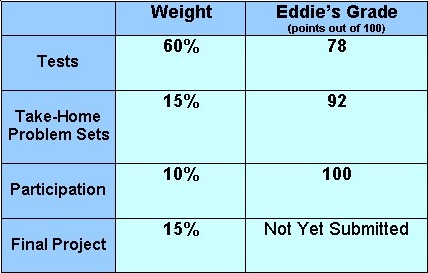
A typical grading structure might look like this:
| Category | Weight |
|---|---|
| Homework | 20% |
| Quizzes | 20% |
| Midterm | 25% |
| Final Exam | 35% |
A student might receive:
| Category | Score |
|---|---|
| Homework | 90 |
| Quizzes | 85 |
| Midterm | 80 |
| Final | 88 |
Weighted grade calculation:(90×0.20)+(85×0.20)+(80×0.25)+(88×0.35)
Weighted averages make grading systems fairer because more important assessments carry greater influence.
Weighted Average in Finance and Investing
Financial analysts frequently use weighted averages when evaluating investments.
Examples include:
- Portfolio return calculations
- Weighted average cost of capital (WACC)
- Stock index calculations
Portfolio Example
| Stock | Investment | Return |
|---|---|---|
| A | $5000 | 10% |
| B | $3000 | 8% |
| C | $2000 | 6% |
Since each investment amount differs, the return must be weighted.
Investors who understand how to do weighted average can measure portfolio performance more accurately.
Weighted Average vs Simple Average
Many people confuse these two concepts.
Here’s the difference.
| Type | Definition |
|---|---|
| Simple Average | Every value counts equally |
| Weighted Average | Values have different importance |
Example
Numbers: 50, 70, 90
Simple average:(50+70+90)÷3=70
Weighted average (weights: 1,2,3):(50×1+70×2+90×3)÷6
Weighted result reflects importance rather than equality.
Common Mistakes When Calculating Weighted Average
Even experienced students make mistakes when learning how to do weighted average.
Frequent errors include:
- Forgetting to divide by total weight
- Using percentages incorrectly
- Confusing weights with values
- Ignoring weight normalization
- Adding weights incorrectly
To avoid mistakes:
- Always confirm the total weight.
- Convert percentages to decimals if necessary.
- Double-check multiplication results.
Small calculation errors can significantly change the final result.
Tools and Methods to Calculate Weighted Average
Today, several tools make the calculation easier.
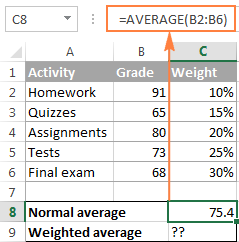
Excel Formula
In Excel:
=SUMPRODUCT(A1:A5,B1:B5)/SUM(B1:B5)
Python Example
import numpy as np
values = [70,80,90]
weights = [1,2,3]
np.average(values, weights=weights)
Calculator Method
- Multiply values by weights
- Add results
- Divide by total weight
Technology simplifies the process, but understanding how to do weighted average manually helps build deeper mathematical intuition.
FAQ
What is the weighted average in simple terms?
A weighted average is an average where some values count more than others. Each number is multiplied by a weight before calculating the final average.
Why do we use weighted averages?
Weighted averages provide more accurate results when values have different levels of importance, such as grades, investments, or survey results.
Is weighted average used in finance?
Yes. Finance professionals use it for portfolio analysis, bond yield calculations, and determining the weighted average cost of capital.
Can weighted averages use percentages?
Yes. Percentages are commonly used as weights. For example, exam scores might have weights like 20%, 30%, and 50%.
What is the difference between weighted mean and average?
They are essentially the same concept. “Weighted mean” is another term used in statistics for weighted average.
How do I calculate weighted average in Excel?
Use the formula:
SUMPRODUCT(values, weights) divided by SUM(weights).
Where are weighted averages used in real life?
They appear in education, economics, stock markets, statistics, polling analysis, and business decision-making.
Can weights be decimals?
Yes. Weights can be decimals, fractions, or percentages depending on the calculation.
Conclusion
Weighted averages may sound like a complicated statistical concept, but once broken down, they become remarkably simple. The idea is straightforward: give more importance to values that matter more.
Learning how to do weighted average allows you to interpret data accurately in academics, finance, and everyday decision-making. Whether calculating grades, analyzing investments, or evaluating performance metrics, the weighted approach offers a more realistic perspective than simple averages.
By understanding the formula, practicing step-by-step calculations, and applying it to real-life situations, anyone can master this valuable mathematical tool. Over time, you’ll start noticing weighted averages everywhere—from school reports to financial news—and you’ll know exactly how they work.